About this event
Overview
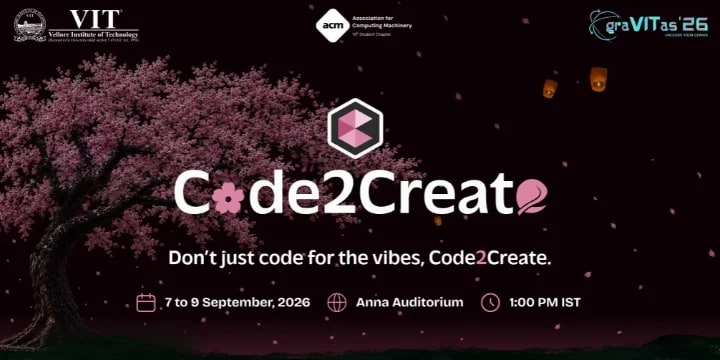
Code2Create 7.0, ACM-VIT’s legacy 48-hour national hackathon, brings together developers, designers, innovators, and problem-solvers from across India to turn ideas into impactful technology.
Participants will work on innovative solutions to real-world problems through an intensive 48-hour development experience, supported by mentorship, multiple evaluation rounds, and expert judging. From ideation and initial progress to building a functional prototype and delivering the final pitch, teams will be challenged to demonstrate creativity, technical excellence, feasibility, and real-world impact.
Who Can Participate?
-The hackathon is open to all. Students, developers, designers, innovators, and technology enthusiasts from across India are welcome to participate.
Why Participate?
-Develop innovative solutions to real-world challenges.
-Showcase your creativity, technical expertise, and problem-solving abilities.
-Experience the intensity of a competitive 48-hour hackathon.
-Receive guidance and feedback through multiple evaluation rounds.
-Network with fellow developers, designers, innovators, and industry experts.
-Compete for recognition and opportunities at one of VIT’s largest student-led technical events.
Team & Participation Rules
-Team size: 2–5 members.
-Team changes will not be permitted after registration closes.
-Teams must select their preferred track/domain during registration.
-Development must begin only after the hackathon officially commences.
-Pre-built projects, prior commits, and reused code are strictly prohibited.
-Plagiarism or any form of malpractice will result in disqualification.
-Participants must bring their own laptops and required software.
-Any external hardware required for the project must be arranged and brought by the respective team.
-All participants are expected to maintain professional, respectful, inclusive, and ethical conduct throughout the event.
Judging Criteria
Projects will be evaluated based on the following criteria:
-Innovation & Creativity
-Problem Relevance
-Technical Complexity
-Implementation & Functionality
-Progress Across Evaluation Rounds
-User Experience (UI/UX)
-Scalability & Future Scope
-Novelty
-Presentation & Communication